
Driven by Lee Iacocca’s vision to capture the post-WWII baby boomer market, the Ford Mustang was created to offer an affordable, sporty, and highly customizable vehicle that sharply contrasted with the bulky, heavy sedans of the 1960s. Featuring a revolutionary “long hood, short deck” proportion, it sold over 400,000 units in its first year alone. The true origin of its name is a fascinating piece of mustang history: while executive stylist John Najjar originally pitched the name “Mustang” to honor the legendary WWII P-51 Mustang fighter plane, Ford executives ultimately approved it because the name evoked the image of a wild, free-roaming horse—perfectly symbolizing untamed American freedom and launching a cultural phenomenon.
Ford Mustang Generational History and Chassis Evolution
To truly grasp the ford mustang evolution, one must look past the changing sheet metal. For buyers, restorers, and engineers, the underlying history is about “technical anchoring.” You need to know exactly which chassis code you are dealing with, when the suspension geometry drastically changed, and how each generation solved the fatal flaws of its predecessor. Understanding these parameters across all mustang years is the ultimate key to value identification and avoiding catastrophic parts-matching errors.
The Classic and Fox Body Era (Gen 1 – Gen 3)
The first three decades established the pony car formula, but the engineering underneath was constantly shifting to find the right balance between cost, weight, and handling.
- Generation 1 (1964.5 – 1973): Built on the Ford Falcon unibody, early models were iconic but suffered from severe chassis flex and vague steering. By 1971, the chassis was widened and stretched just to fit massive big-block V8s, making the car notoriously nose-heavy and prone to understeer. It utilized a rudimentary leaf-spring solid rear axle throughout its run.
- Generation 2 (1974 – 1978): The Mustang II moved to the subcompact Pinto platform. While horsepower was choked by emissions, it introduced a revolutionary Independent Front Suspension (IFS) and rack-and-pinion steering. This completely cured the vague steering of Gen 1 and became a legendary setup for modern hot-rodders.
- Generation 3 (1979 – 1993): The Fox Body era cured the sluggishness of the 1970s through extreme weight reduction. Utilizing a MacPherson strut front and a 4-link coil-spring solid rear axle, the unibody was stripped down to a mere 2,700 lbs in early models. This phenomenal power-to-weight ratio made it the undisputed king of drag racing, though the thin sheet metal meant heavy racing often tore the frame apart.
Technical Anchor: Early Generations Specs & Evolution
| Gen (Years) | Chassis / Base | Suspension Geometry (Front/Rear) | Weight (lbs) | The Engineering Leap (Why it matters) |
| Gen 1 (1964.5-1973) | Falcon Unibody | A-Arm / Leaf Spring Solid Axle | 2,445 – 3,600+ | Established the V8 template, but required massive aftermarket bracing to handle high horsepower safely. |
| Gen 2 (1974-1978) | Pinto Platform | Isolated IFS / Leaf Spring Solid Axle | 2,620 – 3,125 | Introduced Rack-and-Pinion steering, permanently fixing the loose, boat-like handling of the 1960s. |
| Gen 3 (1979-1993) | Fox Platform | MacPherson Strut / 4-Link Coil Solid Axle | 2,700 – 3,200 | Extreme weight reduction and modularity created the ultimate blank canvas for performance tuning. |
Modern Resurgence: The Battle Against Physics (SN95 to S650)
As horsepower climbed into supercar territory in the 1990s and 2000s, the lightweight Fox platform was no longer viable. Engineers had to drastically increase structural rigidity, culminating in the historic death of the solid rear axle.
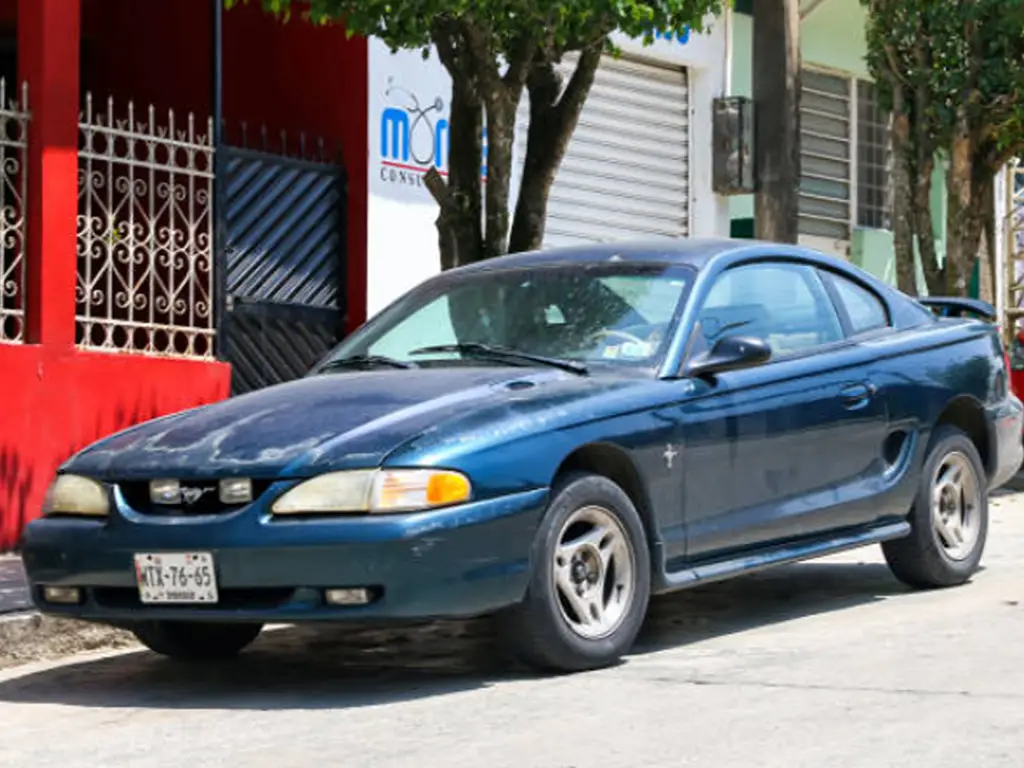
- Generation 4 (1994 – 2004): The SN95 “Fox-4” architecture added a massive 44% increase in torsional rigidity over the Fox Body. Track width was widened, and 4-wheel disc brakes became standard. It finally felt like a solid piece of metal capable of handling supercharged V8s.
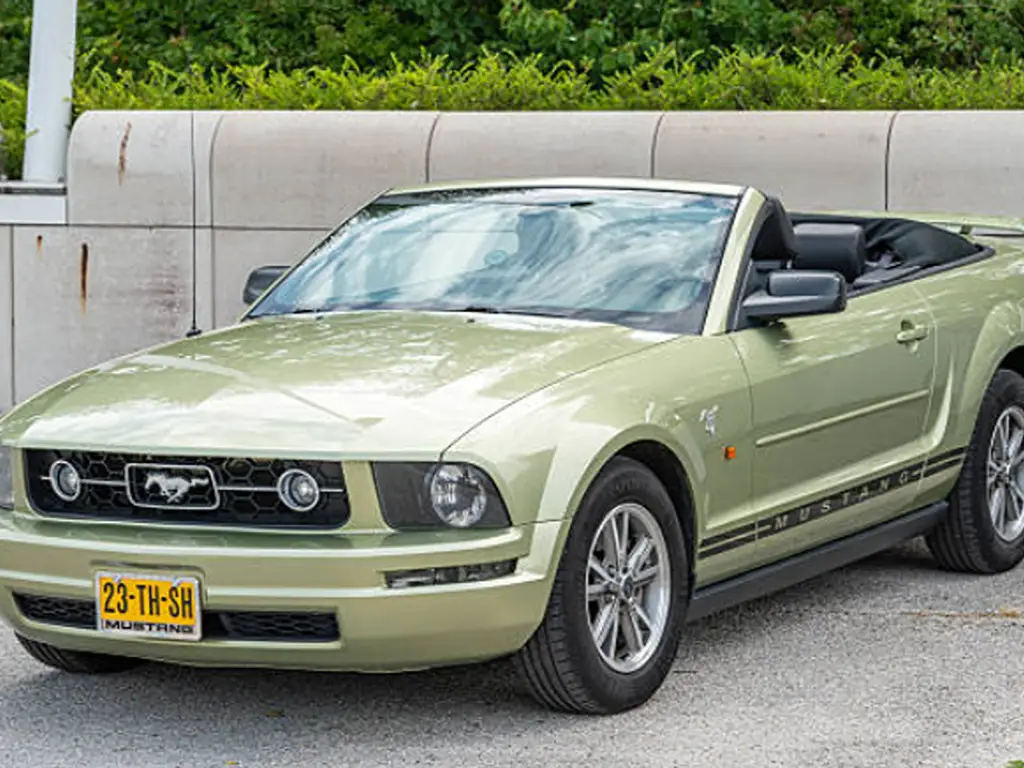
- Generation 5 (2005 – 2014): The S197 moved to the bespoke D2C platform, stretching the wheelbase by 6 inches for high-speed stability. It utilized a 3-link solid rear axle with a Panhard rod. While great for drag racing, the solid axle was pushed to its absolute physical limits—producing violent “axle hop” on bumpy corners when trying to put down the 662 hp of the later Shelby GT500s.
- Generation 6 & 7 (2015 – Present):The Historic IRS Transition. In 2015, the S550 generation completely eradicated the solid rear axle. Ford integrated a heavy-duty Integral-Link Independent Rear Suspension (IRS). This was the ultimate technical anchor in modern mustang history: for the first time, the left and right rear wheels could react to bumps independently, keeping the tires glued to the tarmac and allowing the car to finally corner like a Porsche or BMW. The S650 (2024+) refines this with stiffer steering columns and advanced MagneRide damping.
Technical Anchor: Modern Generations Specs & Evolution
| Gen (Years) | Chassis Code | Suspension Geometry (Rear) | Weight (lbs) | The Engineering Leap (Why it matters) |
| Gen 4 (1994-2004) | SN95 “Fox-4” | 4-Link Solid Axle (IRS exclusive to SVT Cobra) | ~3,200 – 3,400 | Cured chassis flex (+44% rigidity); allowed the platform to handle factory superchargers without twisting. |
| Gen 5 (2005-2014) | S197 (D2C) | 3-Link Solid Axle with Panhard Rod | ~3,350 – 3,800 | Stretched wheelbase improved 150+ mph stability, but the solid axle reached its handling limit on road courses. |
| Gen 6 (2015-2023) | S550 Global | Integral-Link IRS (Standard) | ~3,500 – 3,900+ | Eliminated “axle hop.” The IRS finally allowed 460+ hp to be put down mid-corner on uneven pavement safely. |
| Gen 7 (2024-Present) | S650 | Refined Integral-Link IRS | ~3,800 – 4,000+ | Stiffer steering column and revised mounting brackets deliver European-level steering feedback. |
Mustang Engine Lineage: The V8 Dynasty & Durability Guide
The soul of this vehicle is its V8 powerplant. But for buyers and engine-swappers, horsepower isn’t the only metric—durability is paramount. Knowing which engine blocks split under boost and which ones are practically bulletproof is the most critical technical knowledge in the aftermarket.
- The Windsor Era (Pushrod OHV): Spanning from the classic 289 to the legendary 5.0L High Output (HO) of the Fox Body era, these engines were beloved for their low-end torque and mechanical simplicity. However, they have a known durability limit: the stock 5.0L HO factory engine blocks are notorious for physically cracking or splitting down the middle when pushed past 500 horsepower with aftermarket turbos or superchargers.
- The Modular Era (OHC): Introduced in 1996 to meet emissions, the 4.6L and 5.4L Modular engines transitioned to Overhead Cams. The 2-valve (2V) versions were incredibly reliable but woefully underpowered. However, the 4-valve (4V) versions created legends. The Most Bulletproof Early Modern V8: The 2003-2004 SVT “Terminator” Cobra 4.6L V8 utilized a cast-iron block equipped with forged Manley H-beam connecting rods and forged pistons straight from the factory. It is famously capable of handling 700+ horsepower on stock internals without catastrophic failure.
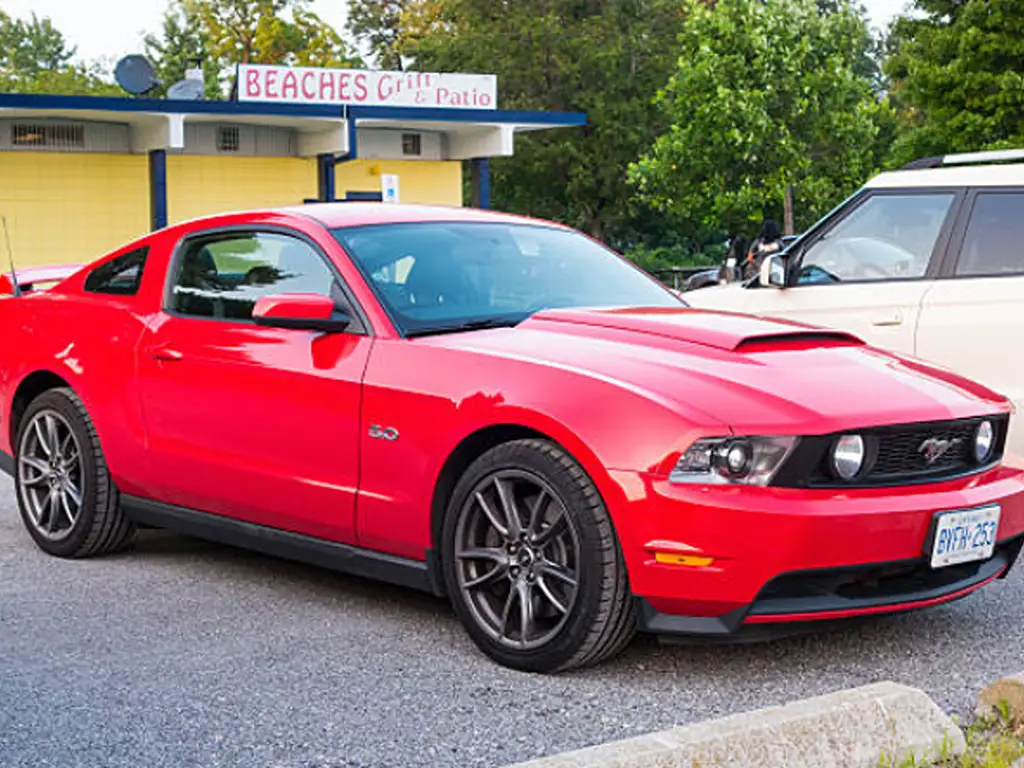
- The Coyote Era (DOHC Ti-VCT): Arriving in 2011, the 5.0L Coyote returned to aluminum blocks but utilized Dual Overhead Cams and Twin Independent Variable Camshaft Timing. The Most Durable Naturally Aspirated V8: The Gen 2 (2015-2017) and Gen 3 (2018+) Coyote engines are engineering marvels. Ford added thicker block webbing, forged crankshafts, and advanced cylinder linings (PTWA in Gen 3). As a result, a modern Coyote can reliably handle 800+ horsepower with a bolt-on supercharger, making it the most robust, high-revving (7,500 RPM) factory V8 ever put in a standard GT.
V8 Engine Identification & Durability Matrix
| Engine Family | Era / Key Models | Architecture | Durability & Tuning Limit (Stock Internals) |
| Windsor 5.0L HO | 1986 – 1995 (Fox Body / Early SN95) | Overhead Valve (Pushrod), Iron Block | Warning: Block tends to split around 450-500 hp. Very cheap to rebuild, but requires an aftermarket block for massive boost. |
| Modular 4.6L (2V/3V) | 1996 – 2010 (SN95 / S197 GT) | Single Overhead Cam (SOHC), Aluminum/Iron | Extremely reliable for daily driving, but powdered-metal connecting rods fail under heavy forced induction (safe limit ~400-450 hp). |
| Modular 4.6L 4V (Terminator) | 2003 – 2004 (SVT Cobra) | Dual Overhead Cam (DOHC), Iron Block | Bulletproof: Factory forged pistons and rods. Can handle 700+ hp with just a supercharger swap and fuel upgrades. |
| Coyote 5.0L (Gen 2/3) | 2015 – Present (S550 / S650 GT) | DOHC, Ti-VCT, Aluminum Block | Apex Durability: Forged crank and heavily webbed block. Routinely handles 800+ hp on stock bottom end with bolt-on force |
Market Valuation and Classic Mustang Investment Pitfalls
Beyond the engineering marvels of the ford mustang evolution, this vehicle represents one of the most active, lucrative, and treacherous classic car markets in the world. However, historic value is rarely distributed evenly. The difference between a $15,000 money pit and a $150,000 auction star lies entirely in historical accuracy, rare factory options, and underlying structural health. Investing in mustang history requires a highly discerning appraiser’s eye to separate genuine artifacts from poorly executed clones.
Historical Retention Rates: Decoding the “Blue Chip” Models
For collectors seeking museum-grade assets, the rule of “Matching Numbers” dictates the top tier of the market. A vehicle where the VIN, engine block casting date, and transmission stamp perfectly match the original factory build sheet will always command a massive premium over a vehicle with a generic replacement V8. In this arena, engine codes are the ultimate currency:
- The “K-Code” & “R-Code” Premium (Gen 1): On early 1965-1967 models, an original “K-Code” equipped with the 289 High-Performance V8 (solid lifters, upgraded internals) can be worth double or triple the value of a standard “C-Code” 289 or a “T-Code” inline-6. By 1968-1970, the “R-Code” 428 Cobra Jet became the holy grail for muscle car investors, offering unparalleled historical retention rates.
- The Homologation Legends: The absolute peaks of the collector world remain the limited-production factory-tuner and homologation specials. Vehicles like the 1965-1966 Shelby GT350s, the monstrous 1969 Boss 429 (built exclusively to legalize the massive engine for NASCAR), and the 1969 Boss 302 Trans-Am racers operate on an entirely different valuation curve, frequently crossing the half-million-dollar threshold at auctions like Mecum and Barrett-Jackson.
- The Rise of the “RADwood” Modern Classics: The market is aggressively shifting to favor later mustang years as Millennials enter their peak earning phase. Flawless, low-mileage Fox Body 5.0L manuals (1987-1993) have seen a 200% value spike in the last five years. Furthermore, limited production SN95s—specifically the 1993 SVT Cobra R, the 2000 SVT Cobra R, and the 2003-2004 “Terminator” Cobras—are rapidly transitioning from used sports cars into highly guarded blue-chip investments.
Red Flags in Restorations: Fraud, Rot, and Ruined ROI
A shiny coat of paint and a rumbling exhaust can easily hide a compromised chassis or, worse, a fraudulent vehicle. When inspecting a classic, buyers and B2B restorers must ruthlessly audit the following critical failure points:
- VIN Cloning and the “Tribute” Trap: Because classic Ford parts are incredibly interchangeable, it is highly common for unscrupulous sellers to take a cheap base-model 6-cylinder chassis, bolt on V8 suspension parts, add Shelby aesthetic body kits, and attempt to sell it as a genuine high-value model. Expert Defense: Always verify the fender apron VIN stamping against the door data plate. For any model from 1967 onward, a buyer should never finalize a purchase without pulling a Marti Report—the officially licensed database that verifies exactly how a Ford vehicle was originally optioned on the assembly line.
- The Gen 1 Cowl Vent Death Trap: Located between the hood and the windshield, the cowl vents are notorious for collecting pine needles and water, rusting the firewall from the inside out. A quick test: if water leaks onto the interior floorboards during a wash, the cowl is compromised. Repairing a rusted cowl properly is a massive labor trap that requires drilling out hundreds of factory spot welds, removing the entire front clip, and pulling the windshield, instantly destroying a project’s ROI.
- Fox Body Metal Fatigue (Gen 3): Because the unibody of the Fox platform was engineered to be exceptionally thin to save weight, aggressive drag racing with modified 5.0L engines often leads to severe metal fatigue. Buyers must inspect the “Torque Boxes” (the critical mounting points where the rear control arms connect to the chassis) and the A-pillars. A Fox Body with ripped, cracked, or poorly re-welded torque boxes has severely compromised structural integrity and dangerous handling geometry.
- The “Restomod” Valuation Ceiling: High-end Restomods (classic bodies sitting on modern independent suspensions with Coyote V8 swaps) can fetch six figures, but only if the engineering is flawless. A poorly welded, pieced-together “Frankenstein” build using cheap, unverified aftermarket suspension components will almost never recoup its build cost. B2B builders must use OE-grade, precision-manufactured structural components to ensure the vehicle handles the modern horsepower safely and retains its premium auction value.
Restomod Reality Check: Cross-Generational Swaps and Parts Sourcing
When builders attempt cross-generational transplants—such as shoehorning a modern Coyote V8 into a 1965 chassis—they face immense spatial constraints. The classic engine bay was designed for narrow pushrod engines. To fit the massive DOHC Coyote heads, the factory shock towers must be completely cut out. This necessitates a custom independent front suspension (IFS) conversion, rack-and-pinion steering, and extensive subframe connectors to prevent the modern horsepower from twisting the 60-year-old unibody. This surgical procedure requires absolute precision and high-quality structural components.
Sourcing these era-specific, discontinued structural components from scrapyards often leads to compromised safety and unpredictable budget overruns. For B2B restoration shops, dealerships, and wholesalers, mitigating this risk requires a reliable partner. As an experienced manufacturer and wholesale B2B distributor, Sunway Autoparts prides foremost on servicing custom and hard-to-find auto parts for your business needs, especially parts for classic cars. If a specific structural component is completely obsolete, we can help you source rare auto parts through our strong supply chain. Furthermore, we own a factory and can make molds for your custom auto parts based on your design or sample. By manufacturing OE specification auto parts with great precision, we ensure you receive high-quality custom parts at profitable pricing, keeping complex Restomod projects authentic and cost-effective.
Conclusion: The Enduring Legacy of the Pony Car
The six-decade journey of this iconic vehicle is a testament to the power of automotive adaptability. From its inception as an affordable youth icon to its modern iteration as a globally respected track weapon, it has survived shifting economies and technological revolutions. By understanding its deep engineering roots, the evolution of its V8 heart, and the nuances of cross-generational architecture, enthusiasts and professionals alike can ensure that this piece of automotive history continues to dominate the streets and restoration bays for decades to come.


 English
  Spanish
  French
  German